Puente San Miguel Arcángel
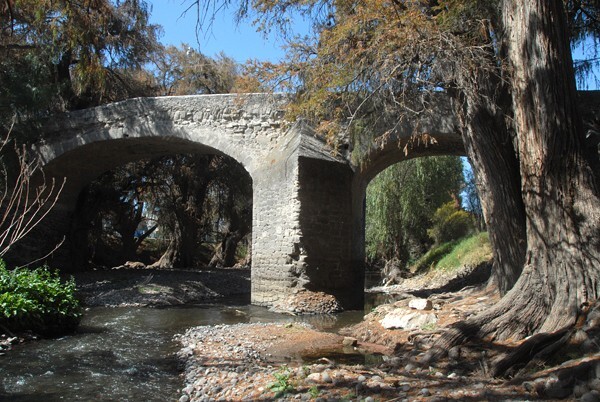
Built in 1665 it is locally known as "El puente de la otra banda" ("the bridge to the other side").
A nearby marker reads as follows, translated from the Spanish:
"Until recently an inscription was still legible on a stone at the apex of the bridge’s support arch, which read as follows: 'While serving as mayor of this town of Itzmiquilpan, Captain Don Miguel de Cuevas Dávalos built this bridge at his own expense and with contributions from the local residents; year 1655.'
This marvel of colonial-era engineering was designed to facilitate pedestrian traffic and the passage of animal-drawn carts across the Tula River. It enabled the movement of supplies and goods from important mining centers such as Pachuca, Real del Monte, and Cardonal, as well as those of Zimapán and the Sierra Gorda. More broadly, it connected central Mexico with the Northern regions and the Bajío via the Camino Real. Although the art of building bridges was not well-known in pre-Hispanic Mexico, Otomi workers directed by European builders combined aesthetics and stability in what is a rich artistic achievement.
The construction was carried out with the technique of the time and some medieval artistic touches; its arches preserve a cobblestone paving of river stone fused with lime mortar. At the top of the bridge there was a monument dedicated to St. Michael with a marker on the parapet indicating the date of its construction. On the western end of the bridge there are two niches that were part of restoration, after a 17th century flood.
Austere, majestic, and imposing, this venerable bridge still stands, hoping to one day become a National or World Heritage Site.