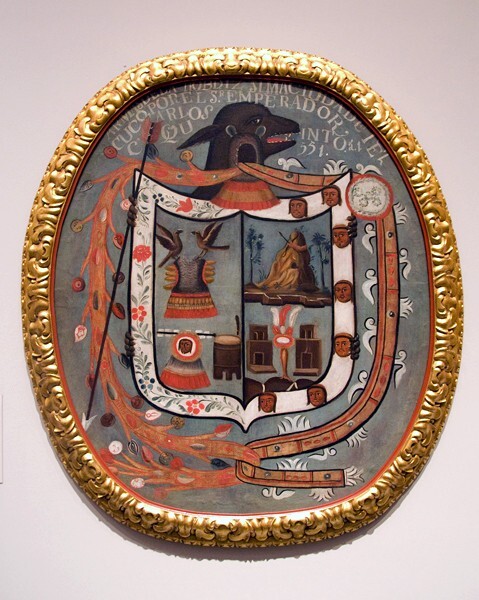
Escudo de Armas de Texcoco
Provenance:
Colección de Felipe Siegel
Anna & Andrés Siegel, Ciudad de México
This painting was included in the exhibition Contested Visions in the Spanish Colonial World, held at the Los Angeles County Museum of Art from November 6, 2011, to January 29, 2012 as no. 88 (illustrated in color on p. 115 of the exhibition catalogue). The exhibition traveled to the Chapultepec Castle, Mexico City from July 6 to October 7, 2012. An accompanying museum tag in Los Angeles read:
"The city-state of Texcoco was a member of the Aztec Triple Alliance. The coyote, whose paws hold the sides of the city’s shield, refers to the Texcocan ruler Nezahualcoyotl. Including the ruler’s military costume emphasized the city/s might. Another Mesoamerican symbol is the interlocking ribbons with the symbol of water and fire, denoting sacred war. The combination of preconquest imagery and European insignia allowed the 18th century indigenous nobility to emphasize their links to powerful ancient rulers."
detail:

Colección de Felipe Siegel
Anna & Andrés Siegel, Ciudad de México
This painting was included in the exhibition Contested Visions in the Spanish Colonial World, held at the Los Angeles County Museum of Art from November 6, 2011, to January 29, 2012 as no. 88 (illustrated in color on p. 115 of the exhibition catalogue). The exhibition traveled to the Chapultepec Castle, Mexico City from July 6 to October 7, 2012. An accompanying museum tag in Los Angeles read:
"The city-state of Texcoco was a member of the Aztec Triple Alliance. The coyote, whose paws hold the sides of the city’s shield, refers to the Texcocan ruler Nezahualcoyotl. Including the ruler’s military costume emphasized the city/s might. Another Mesoamerican symbol is the interlocking ribbons with the symbol of water and fire, denoting sacred war. The combination of preconquest imagery and European insignia allowed the 18th century indigenous nobility to emphasize their links to powerful ancient rulers."
detail:
|
Also in: Felipe Siegel Collection
 |