Female Saints
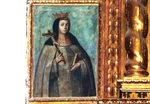 A striking mural of Saint Helena is found on the second story cloister walk of the Franciscan convento of San Juan Bautista in the city of Metepec, East of Toluca in Mexico state. With halo about her head and beautifully crowed, she holds a scepter in her left hand while signaling down with her right to the unearthing of the three Calvary crosses and her verification of the True Cross:
“St. Helena, the mother of the Roman Emperor, Constantine the Great, was converted to Christianity after the victory of Constantine over his rival Meaxnetius. It was during this battle that Constantine is reported to have seen a vision of Christ bearing a banner inscribed with the Latin words ‘In hoc signo vinces’ (By this sign shalt you conquer). Constantine, adopting this message as his motto, became a Christian. As a token of her piety, St. Helena ordered a number of churches to be built and, at the age of eighty, undertook a religious pilgrimage to the Holy City of Jerusalem. There she was particularly interest in the Mount of Calvary, where Christ had been crucified, and caused various excavations to be made. She is said, as a result, to have unearthed three crosses and the inscription, ‘Jesus of Nazareth, King of the Jews’, which Pilate had commanded to be nailed upon the Cross of Christ. To determine which of the three crosses was that upon which the Saviour died, St. Helena caused a man who was very ill to be placed on each of the crosses in turn. When he touched the True Cross, he was miraculously cured. During later excavations, at St. Helena’s direction, some of the nails used to affix Crist to the Cross were discovered. When unearthed, they were ‘shining as gold’. Two of these nails she gave to her son, Constantine. He used one as an emblem on the bridle of his horse; he wore the other upon his helmet.” (Ferguson, George. Signs and Symbols in Christian Art, A Galaxy Book, Oxford University Press, New York, 1966, X Saints, pps. 122-3) Note: There is some question as to whether the ill person placed before the crosses was a man or women. Rufinus of Aquileia (344/345–411) provided the earliest detailed surviving narrative ([circa 402) in his translation of Eusebius’s Church History, in which he describes the miraculous healing of a dying woman. However, later accounts mention a sick man; a (circa 403) letter by Paulinus of Nola (354-431) describes the resurrection of a deceased man before the True Cross. |
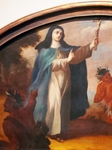 St. Mary of Jesus of Ágreda, Santa María de Jesús de Ágreda (1602-1665), was 16 years old when she, her mother Catalina and sister Jerónima entered the Order of Conceptionist nuns, converting their home (in 1619) into a convento, whose expanded reconstruction began in 1627.
 Images of her occasionally appear in Mexico, either as a proselytizer, as in José de Páez’s mid-18th century painting of her, or in the cases at Landa de Matamoros (Querétaro) and La Guadalupe (Zacatecas) as an author, most likely in the processes of penning her six-volume Mystical City of God (Mística Ciudad de Dios, Vida de la Virgen María). The work was first published in Madrid in 1670 although shortly banned by Pope Innocent XI because it promoted the belief in the Immaculate Conception of the Virgin Mary, not merely that of Christ himself. This construct was not Catholic dogma until as late as 1854, despite the fact that the Franciscans actively championed it as actuality. Ágreda’s influence in the New World was largely felt in the modern-day state of New Mexico at the Salinas Missions South of Albuquerque, now in ruins. Gifted with the mystical phenomenon of bilocation, even as a young child María had experienced ecstatic visions in the presence of the Lord. In the 1620s she began having particularly intense dreams, thought to be more like hypnotically altered states. During these reveries Ágreda was conveyed to a distant continent where she taught the Gospel to an idolatrous people. This land presented itself as modern day New Mexico and West Texas, and the pagans as indigenous Americans including the Jumanos. |