Folding Screen (Biombo) with Indian Wedding and Fyling Pole
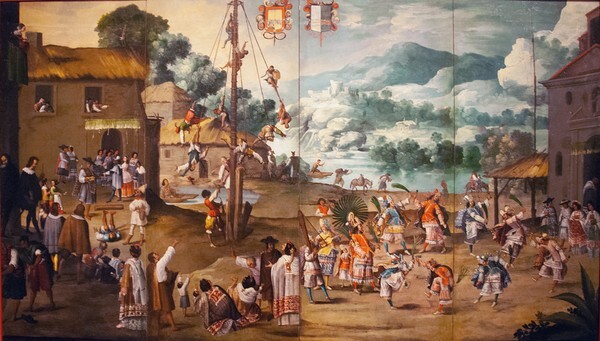
This work of art was purchased by the Los Angeles County Museum of Art with funds provided by the Barnard and Edith Lewin Collection of Mexican Art Deaccession Fund.
Exhibited:
Los Angeles, County Museum of Art, Contested Visions in the Spanish Colonial World, Nov., 2011 – Jan. 29, 2012. The exhibition traveled to Mexico City, Museo Nacional de Antropología in Mexico City, Summer, 2012.
The exhibition wall label read:
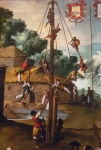
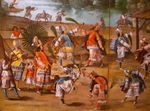
"The folding screen (biombo) depicts an Indian celebration in a village, probably Ixtacalco, a famous destination in the environs of Mexico City. On the right, the newlywed Indian couple leaves the church. A number of figures participate in the pre-Hispanic traditions that continued in colonial times. Several dancers in lavish costumes perform a mitote, a dance with a figure impersonating the Aztec king Moctezuma. In the center, figures dangle from the fling pole (palo volador), and to the left an Indian juggles a log with his feet before the dazzled crowd. In the far right a maguey plant suggests that the consumption of pulque (an intoxicating local beverage) was part of the celebration. The screen satisfied European curiosity about the New World. It also proved that the conversion of the natives had been successful by showing them partaking of one of the most important Christian sacraments, marriage."
Exhibited:
Los Angeles, County Museum of Art, Contested Visions in the Spanish Colonial World, Nov., 2011 – Jan. 29, 2012. The exhibition traveled to Mexico City, Museo Nacional de Antropología in Mexico City, Summer, 2012.
The exhibition wall label read:
"The folding screen (biombo) depicts an Indian celebration in a village, probably Ixtacalco, a famous destination in the environs of Mexico City. On the right, the newlywed Indian couple leaves the church. A number of figures participate in the pre-Hispanic traditions that continued in colonial times. Several dancers in lavish costumes perform a mitote, a dance with a figure impersonating the Aztec king Moctezuma. In the center, figures dangle from the fling pole (palo volador), and to the left an Indian juggles a log with his feet before the dazzled crowd. In the far right a maguey plant suggests that the consumption of pulque (an intoxicating local beverage) was part of the celebration. The screen satisfied European curiosity about the New World. It also proved that the conversion of the natives had been successful by showing them partaking of one of the most important Christian sacraments, marriage."
|
Previous (4 of 4)
|
|
Return to: Folding Screen (Biombo) with Indian Wedding and Flying Pole or Los Angeles, California, County Museum of Art or Gallery
Also in: Folding Screen (Biombo) with Indian Wedding and Flying Pole
 |  |  |