Nave murals
Listed below in order of publication date are numerous sources regarding the Ixmiquilpan nave murals, some of which are cited within this text. Also following are the definitions of certain Nahuatl words meant to assist in identifying the figures within the individual photo descriptions. The images largely consist of intense battle scenes in which indigenous warriors clash amidst centaurs and monsters in a melee of military attire, native weaponry, and body limbs. Utterly remarkable is that never present is the slightest reference to Christianity or the Holy Bible, to the monastery's patron saint, or even to the Augustinian order which founded the convento.
Nevertheless, the images are prominent, large-scale in format, meant to be viewed by all on their way down the nave to the sanctuary to take Holy Communion. Defying precedent and protocol, to this day the mural cycle is “enigmatic, because in spite of the efforts of scholars to identify a precise source for their iconography, or offer interpretations on the projections of its imagery, we are still far from finding a definitive answer to the many questions which the murals pose.” (Wake, p. 106)
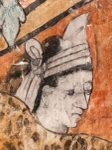
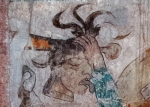
The most substantial, dynamic, and intricate battle murals are on the aisle’s South wall between the narthex at the façade's West entrance and the chancel arch to the presbytery at the East end of the church. Two groups are at war: a.) the culturally advanced, sedentary indigenous, presumably the local Otomí who, depending on their hierarchy, appear in full body battle attire (tlahuiztli) as jaguar, coyote, ocelot, or eagle warriors with elegant headdresses (copilli), and who fright with obsidian edged clubs (maquahuitl), the arrow launching átlatl (albeit absent from the scenes), and standout shields (chimalli), versus b.) the feral, seminomadic hunter-gatherer tribes generally subsumed under the single name of Chichimeca. They fight naked save for their knotted loincloths (maxtlatl) and propel the arrow with a traditional bow (tlahuitolli). “De otra arma, más que de arco y flecha, no usan.” (de las Casas, p. 14). Warring on the side of the Chichimecas are an assortment of monstruos mythological creatures seemingly plucked right out of Greek mythology.
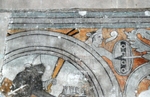
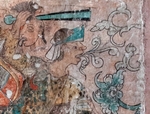
Incorporated into the scenes are ornate acanthus leaf foliage and any number of small, demonic faced creatures who nevertheless do not seem to participate in the narrative, much like grotesque elements common to dado or frieze murals throughout monastic New Spain. Running along the nave walls at a much higher level, and therefore difficult to make out, is a traditional looking frieze, which was never painted over but which does, in fact, integrate the fabled looking fiends of the lower murals with Augustinian insignia within cartouches. The battle murals, however, act as a wainscoting of sorts along the lower walls -- large, imposing, inescapable scenes meant to drive home a didactic narrative rather than simply adorn eye level space.
While interpretations vary, one must keep in mind that the Augustionian friars who oversaw the convento's construction were in total charge of all aspects of its decoration, as had been the case in Medieval Europe and certainly was in New Spain. “… la planeación iconográfica de escultores y pintores se hizo siempre bajo la dirección y aprobación de los monjes y de los frailes.” (Reyes-Valerio, p. 34). The native tlacuilos who painted the scenes could not have acted independently, disobeyed instructions, nor would the friars have failed to notice largescale transgressions. Rather, what one has here is the most conspicuous form of monastic adaptation in 16th century Mexico.
In New Spain, the evangelization endeavor of the Franciscans and Dominicans bega earlier than that of the Augustinians, the first seven of whom did not arrive until 1533. Their situation was therefore “delicate, for their predecessors had taken possession of all New Spain, strongly in some places, more weakly in others. They had to squeeze their missions into the gaps left by the Franciscans and Dominicans, which is the reason why the geographical limits of their apostolate were much less sharply defined.” (Ricard, pps. 68-69).
While the Augustinians occupied territory in Morelos unclaimed by the other two mendicant orders, their campaign of conversion mostly took them to the Northern frontier, Northeast into the Sierra Alta of Hidalgo and Northwest into present-day Michoacán, where they were faced hunter-gatherers who lacked the hierarchical, urban and politically centralized structure through which Christian conversion could be facilitated. In fact, in 1591 the Crown began sending Tlaxcalans North to settle in the so-called Gran Chichimeca region with the goal of pacifying and evangelizing the nomadic peoples by exemplifying Christian life.
Only about 70 miles North of Mexico City, at the time Ixmiquilpan was indeed situated in dangerous territory, traversed by Chichimecas who plagued Spanish missionaries and soldiers alike, the latter as they guarded the precious silver roads North to Guanajuato and far-off Zacatecas. What may be considered an extension of the Mixtón War (1540-42), which took place in modern day Jalisco, the Chichimeca War continued intermittently to the end of the 16th century all about Northcentral Mexico and the Gran Chichimeca. In fact, later Franciscan and Jesuit foundations in far Northern Spanish territories came to be called "presidio-missions" as the churches were defended by nearby garrisons.
Crafted to protect the rights of the indigenous, in 1542 King Charles V issued his New Laws, the Leyes y ordenanzas nuevamente hechas por su Magestad para la gobernación de las indias y buen tratamiento y conservación de los indios to the disdain of ex-conquistador encomienda owners but to the gratification of many New World friars. Nevertheless, many of these same mendicants ultimately insisted that the Laws could not apply to the Chichimecas who, unlike their conquered sedentary counterparts by whom the friars loyally stood, the nomadics had irremediably proven themselves unconvertible and uncivilizable. The never dormant Aristotelian principle of Just War was espoused to Archbishop Alonso de Montúfar who in 1569 convened a conclave of priests to weigh in on the situation and whose “respuesta unánime a favor de la Guerra chichimeca…tuvo gran eco en la Nueva España” (Hernández, p. 126). No doubt this echo was heard loud and clear in Ixmiquilpan, that it was to be a "guerra a fuego y sangre." (ibid., passim)
Frays Andrés de Mata planned the monastery of San Miguel Ixmiquilpan and had it built in the 1550s high up over its atrio so as to not disrupt the ancient Otomí plaza. A speaker of both Otomí as well as Nahuatl, de Mata was prior of San Miguel “durante muchos años, quizá hasta la celebración del capítulo en ese lugar en 1572, en un momento en que la amenaza chichimeca estaba aún candente.” (de Gerlero, p. 583). Influenced by resounding sentiment against the Chichimecas, de Mata must have sectioned off a portion of his church, i.e. its nave, to pictorially address this red hot issue to his congregation, all the while retaining cloister and sacristy walls for customary conventual mural scenes.
The visual messaging actually begins on the church façade with the two unusual “escudos”, or escutcheons, emblazoned with carved images (eagle, jaguars, a footpath, running water) replicated in the some of the first murals encountered just inside the church, to either side of the sotocoro vault. Here, Ixmiquilpan's altepetl (toponym) is displayed beside the most powerful and prestigious symbols in Aztec religion and war, the eagle and the jaguar. The low rising succulent purslane paint is juxtaposed by prickly pear cacti, the former the Nahuatl definition of the Otomí city "Ixmiquilpan", the latter for the magnificent former capital of the Aztec Empire, "Tenochtitlan", all in unifying recognition of both cultures. A fiery red eagle comes into view in the sotocoro webbing, offset all the way across the church in the presbytery vault ribbing by an image of the Aztec deity Tezcatlipoca, the night jaguar, if not Huitzilopochtli, the God of War.
The tlacuilo artists themselves were likely either of Otomí or Aztec lineage. In authorizing the mural programme de Mata and his Augustinian cohorts must have furnished tangible, viewable material from which the indigenous artists could depict the famous nave battle murals, which they surely first sketched out on paper before scaling them for transfer to the walls. According to Augustinians chronicler Juan de Grivalja (1580-1638), de Mata had studied art and architecture in Italy under a certain well-known master, no doubt accounting for the Renaissance style, multi-tiered coffered archivolts over the façade portals at both Ixmiquilpan and the larger convento of San Nicolás de Tolentino (Actopan) which he also founded, 23 miles East in Hidalgo’s Mezquital Valley.
 Ovid's Metamorphosis, published by Zoppino, Venice, 1533; translated from Latin by Niccolò degli Agostini
No doubt de Mata had been to Florence, nucleus of the Renaissance, where in 1554 Benvenuto Cellini’s completed his Perseus with the Head of Medusa directly inspired by Ovid’s Metamorphosis. The magnificent sculpture was immediately unveiled to the Tuscan public in the Loggia dei Lanzi, where it still stands today. Other masterpieces based on the Metamorphosis would soon follow, as Ovid's epic poem was experiencing an exceptional revival in 16th century Europe. Known colloquially as the "Painter's Bible" or "Sculptor's Manual," new publications were in circulation, replete with illustrations of its hybrid human/animal creatures (such as the centaur) surrounded by historiated borders, all ripe for artistic reproduction. Copies soon arrived in New Spain, nine in fact “en el solo año de 1576.” (Gruzinski, n.p.)
For the Augustinianss the battle murals served a practical purpose. Magnificently attired, Christianized natives slaughter the savage Chichimecas in what surely was spectacular recruitment propaganda for the local Otomís to join forces with the Spanish versus their shared nemesis, as had done the Tarascans in the Mixtón conflict. At about this time (1568-69) the Augustinian church at Chapulhuacán (Hidalgo), monastery at Xilitla (San Luis Potosí), and mission station at Jalpan (Querétaro) were all attacked with three of their friars killed (possibly 1572). The Ixmiquilpan images had the practical purpose of underscoring the predicament, illustrating and validating the modus operandi to stave off the assailants and forestall further casualties.
The murals also served a dogmatic purpose. As has been broadly proposed, in broader terms they acted as a psychomachia -- title of the highly influential and routinely referenced fifth century poem by the Christian Roman author Aurelius Clemens Prudentius -- in which an allegorical battle of the soul is invoked, an internal clash between virtue and vices, good and evil, with the perpetual admonition to never sway from Christian probity. The psychomachia manifestation is not necessarily unique to Ixmiquilpan. The inexhaustible carvings about the open chapel to the Franciscan convento at San Luis Obispo in Tlalmanalco (México state) also bear the visual evidence of a psychomachia (see Curiel, Gustavo. Tlalmanalco, historia e iconología del conjunto conventual, UNAM, Ciudad de México, 1988), as do to a modest degree the dado murals of the Sala de las Sibilas in Puebla’s Casa del Deán, where devilish centaurs and monkeys gambol about.
Since the tlacuilos themselves remain anonymous, one cannot speculate either on their ages nor to their collective memory or ancestral appreciation of their own pre-Hispanic world, which most probably they had partially lived in their youth. Save perhaps for one group of figures, the palpable presence of Ovidian imagery at Ixmiquilpan remains speculative, as does the influence in general of classical mythology on Colonial Spanish art. Nevertheless, civilizations isolated in time and geography such as Greco Roman and Mesoamerican cultures can nevertheless produce similar, even identical, archetypes and mythologems. The Ixmiquilpan tlacuilos metamorphosed the Ausutinian source images into their own pre-Hispanic world, balancing eagle and jaguar, resurrecting battle paraphernalia, possibly even introducing the Cihuateteotl divine woman (North wall).
Furthermore, most figures are endowed with fanciful speech scrolls (an essential element to Aztec art) so as to seemingly bestow sound upon the scenes. Eleanor Wake proposed that the Ixmiquilpan murals simulate the Cantares Mexicanos, a 16th-century manuscript collection of traditional Aztec warrior songs and poems written in the Classical Nahuatl language a few decades after the fall of the Empire, the earliest documentation for which dates from 1550-1555. The Cantares Mexicanos are filled with intense song imagery that blends flowers and the battlefield, suggesting historic accounts of the Flower Wars fought by the Aztec Triple Alliance (Tenochtitlan-Texcoco-Tlacopan) against their Tlaxcala-Puebla enemies, circa 1454 until the Spanish arrival.
This is the Nahuatl “canto y flor”, the disfrasismo (bipartite metaphor) which is the Aztecs’ paradoxical philosophy of beauty and impermanence. Yet its manifestation at San Miguel does not present a subversion of Christianity or even a revitalization of paganism (see Bierhorst, Revilatization, pps. 60-69) since the Augustinians were not threatened by the art work they had authorized, even if incapable of fully appreciating its significance. The flower dies and the song ends, but at Ixmiquilpan they were welcomed, at least for one last curtain call.
Nahuatl Vocabulary:
Altepetl literally, "city state"; foundational toponym suffix in Nahuatl: atl (water) & tepetl (hill/mountain)
Atlatl arrow or dart launcher for long range warfare used by the Aztecs
Cihuateteotl or
Cihuapilli;
pl. Cihuateteo or
Cihuapipiltin) fearsome spirits in Aztec mythology representing women who died during childbirth
Chimalli traditional shield used by Aztec warriors
Copilli conical headdress worn by Aztec warriors, nobility, and priests
Maquahuitl hardwood panel with obsidian blades used as a weapon by the Aztec military for close combat
Maxtlatl loincloth
Pantli Aztec banner, flag, insignia, standard, pole, or mast
(pl. pamitl)
Tlahuitolli traditional bow used by seminomadic indigenous
Tlahuiztli elaborate, full-body war suit worn by elite Aztec warriors and nobles
Further Reading:
Gonzalo de las Casas, La Guerra de los Chichimecas, editor Manolo Palomares, 2024 (originally written 1571-1580).
* research by Alberto Carrillo Cázares has revealed that the 1575-80 treatise Guerra de Los chichimecas in fact was not written by encomendero Gonzalo de las Casas but rather by Ausutinian friar Guillermo de Santa Maria who was stationed at the mission of San Felipe (Northern Guanajuato) in 1571 before it was abandoned four years later because of Chichimeca raids. Instead de las Casas is still accredited as having written Noticias de los Chichimecas y justicia de la guerra que se hace por los españoles, circa 1572.
Abelardo Carrillo y Gabriel, Ixmiquilpan, Instituto Nacional de Antropología e Historia, Ciudad de México, 1961.
Robert Ricard, The Spiritual Conquest of Mexico, University of California Press, Berkley, Los Angeles & London, 1966,
Francisco de la Maza, La mitología clásica en el arte colonial de México, UNAM, 1968, pps. 46-48.
Harrier Kamm Nye, The Talking Murals at Ixmiquilpan, The Mexican Quarterly Review, Vol. 3, No. 2, Feb., 1968.
Philip Wayne Powell, Soldiers, Indians and Silver: The Northern Advance of New Spain, 1550-1600, University of California Press, Berkeley & Los Angeles, 1969
Constantino Reyes-Valerio, Arte Indocristiano: Escultura del siglo XVI en México, INAH, Ciudad de México, 1978
Donna Pierce, Identification of the Warriors in the Frescoes of Ixmiquilpan, Review Research Center for the Arts, Vol. 4, No. 43, Oct., 1981.
Cantares Mexicanos: Songs of the Aztecs, translated from the Nahuatl with an Introduction and Commentary by John Bierhorst, Stanford University Press, California, 1985.
Victor Manuel Ballestreros García, La orden agustina en Nueva España (Expansión septentrional en el siglo XVI), pensamiento y expresión, UNAM, Ciudad de México, 1991, Capítulo 13: Ixmiquilpan, pps. 191-208.
Richard Perry, Mexico’s Fortress Monasteries, with illustrations by the author, Espadaña Press, Santa Barbara, California, 1992, Ixmiquilpan, pps. 62-66.
Raúl Guerrero Guerrero, Murales de Ixmiquilpan, Gobierno del Estado de Hidalgo, Pachuca, 1992.
Alicia Albornoz Bueno, La memoria del olvido: El lenguaje del tlacuilo, glifos y murales de la iglesia de San Miguel Arcángel Ixmiquilpan, Universidad Autónoma de Hidalgo, Pachuca, 1994.
Oliver Debroise, Imaginario fronterizo/identidad en tránsito. El caso de los murales de San Miguel Ixmiquilpan. Arte, historia e identidad en América: Visiones comparativas, UNAM, Ciudad de México, 1994, pps. 155-172.
Serge Gruzinski, Entre monos y centauros, los indios pintores de la cultura de Renacimiento, a los caminos del mestizaje, Condumex, Ciudad de México, 1996.
David Charles Wright Carr, Sangre para el sol: las pinturas murales del siglo XVI en la parroquia de Ixmiquilpan, Hidalgo, Memorias de la Academia Mexicana de la Historia, correspondiente de la Real de Madrid, tomo 41, 1998, pp. 73-103.
Eleanor Wake, Sacred Books and Sacred Songs from Former Days: Sourcing the Mural Paintings at San Miguel Arcángel Ixmiquilpan, UNAM, Estudios de Cultura Náhuatl, Vol. 31, 2000, pps. 106-140)
José Luis Pérez Flores, Sometimiento y feminidad. Análisis de género en los murales de Ixmiquilpan, UNAM, Ciudad de México, 2007, Tesis, Programa de Maestría en Historia de Arte.
Mónica Domínquez, Negotiating Identities, Chivalry and Antiquity at San Miguel Ixmiquilpan, UNAM, Mexico City, 2007
Arturo Vergana Hernández, Las pinturas del templo de Ixmiquilpan: ¿Evangelización reivindicación indígena o propaganda de guerra, Universidad Autónoma del Estado de Hidalgo, Pachuca, 2010
Michael K. Schuessle, Mural Painting and Missionary Theater in New Spain, Foundational Arts, University of Arizona Press, Tucson, 2013, Chapter 4, pps. pages 124–158.
Elena Isabel Estrada de Gerlero, Muros, sargas y papeles. Imágenes de lo sagrado y lo profano en el arte novohispano del siglo XVI, UNAM, Ciudad de México, 2011, El friso monumental de Itzmiquilpan, pps. 563-584.
Luis Corrales Vivar-Cravioto, Convento de San Nicolás de Tolentino, Actopan; Convento de San Miguel Arcángel, Ixmiquilpan, Mina Editorial para la Dirección General de Publicaciones e Impresos del Gobierno del Estado de Hidalgo, Pachuca, 2012.
Robert Jackson, Conflict and Conversion in Sixteenth Century Central Mexico: The Augustinian War on and beyond the Chichimeca Frontier, Brill Academic Publishers, Leiden, The Netherlands, Chapter 4: The Holy War against the Chichimecas: The Ixmiquilpan Church Mural Series, 2013.
José Luis Pérez Flores & Sergio González Varela, Los murales del Convento de Ixmiquilpan, México, y la imagen de guerra occidental, Universidad Autónoma de San Luis Potosí, México, Colonial Latin American Review, 22:1, March 12, 2013, pps. 126-147.
ed. Chris Askholt Hammeken & Maria Farbicius Hansen. Ornament and Monstrosity in Early Modern Art, Taylor & Francis Group, Milton Park, Abingdon-on-Thames, Oxfordshire, Chapter IV: That savage should mate with tame: Hybritidy, Indeterminancy, and the Grotesque in the Murals of San Miguel Arcángel (Ixmiquilpan, Mexico) by Barnaby Nygren, 2025.
Nevertheless, the images are prominent, large-scale in format, meant to be viewed by all on their way down the nave to the sanctuary to take Holy Communion. Defying precedent and protocol, to this day the mural cycle is “enigmatic, because in spite of the efforts of scholars to identify a precise source for their iconography, or offer interpretations on the projections of its imagery, we are still far from finding a definitive answer to the many questions which the murals pose.” (Wake, p. 106)
The most substantial, dynamic, and intricate battle murals are on the aisle’s South wall between the narthex at the façade's West entrance and the chancel arch to the presbytery at the East end of the church. Two groups are at war: a.) the culturally advanced, sedentary indigenous, presumably the local Otomí who, depending on their hierarchy, appear in full body battle attire (tlahuiztli) as jaguar, coyote, ocelot, or eagle warriors with elegant headdresses (copilli), and who fright with obsidian edged clubs (maquahuitl), the arrow launching átlatl (albeit absent from the scenes), and standout shields (chimalli), versus b.) the feral, seminomadic hunter-gatherer tribes generally subsumed under the single name of Chichimeca. They fight naked save for their knotted loincloths (maxtlatl) and propel the arrow with a traditional bow (tlahuitolli). “De otra arma, más que de arco y flecha, no usan.” (de las Casas, p. 14). Warring on the side of the Chichimecas are an assortment of monstruos mythological creatures seemingly plucked right out of Greek mythology.
Incorporated into the scenes are ornate acanthus leaf foliage and any number of small, demonic faced creatures who nevertheless do not seem to participate in the narrative, much like grotesque elements common to dado or frieze murals throughout monastic New Spain. Running along the nave walls at a much higher level, and therefore difficult to make out, is a traditional looking frieze, which was never painted over but which does, in fact, integrate the fabled looking fiends of the lower murals with Augustinian insignia within cartouches. The battle murals, however, act as a wainscoting of sorts along the lower walls -- large, imposing, inescapable scenes meant to drive home a didactic narrative rather than simply adorn eye level space.
While interpretations vary, one must keep in mind that the Augustionian friars who oversaw the convento's construction were in total charge of all aspects of its decoration, as had been the case in Medieval Europe and certainly was in New Spain. “… la planeación iconográfica de escultores y pintores se hizo siempre bajo la dirección y aprobación de los monjes y de los frailes.” (Reyes-Valerio, p. 34). The native tlacuilos who painted the scenes could not have acted independently, disobeyed instructions, nor would the friars have failed to notice largescale transgressions. Rather, what one has here is the most conspicuous form of monastic adaptation in 16th century Mexico.
In New Spain, the evangelization endeavor of the Franciscans and Dominicans bega earlier than that of the Augustinians, the first seven of whom did not arrive until 1533. Their situation was therefore “delicate, for their predecessors had taken possession of all New Spain, strongly in some places, more weakly in others. They had to squeeze their missions into the gaps left by the Franciscans and Dominicans, which is the reason why the geographical limits of their apostolate were much less sharply defined.” (Ricard, pps. 68-69).
While the Augustinians occupied territory in Morelos unclaimed by the other two mendicant orders, their campaign of conversion mostly took them to the Northern frontier, Northeast into the Sierra Alta of Hidalgo and Northwest into present-day Michoacán, where they were faced hunter-gatherers who lacked the hierarchical, urban and politically centralized structure through which Christian conversion could be facilitated. In fact, in 1591 the Crown began sending Tlaxcalans North to settle in the so-called Gran Chichimeca region with the goal of pacifying and evangelizing the nomadic peoples by exemplifying Christian life.
Only about 70 miles North of Mexico City, at the time Ixmiquilpan was indeed situated in dangerous territory, traversed by Chichimecas who plagued Spanish missionaries and soldiers alike, the latter as they guarded the precious silver roads North to Guanajuato and far-off Zacatecas. What may be considered an extension of the Mixtón War (1540-42), which took place in modern day Jalisco, the Chichimeca War continued intermittently to the end of the 16th century all about Northcentral Mexico and the Gran Chichimeca. In fact, later Franciscan and Jesuit foundations in far Northern Spanish territories came to be called "presidio-missions" as the churches were defended by nearby garrisons.
Crafted to protect the rights of the indigenous, in 1542 King Charles V issued his New Laws, the Leyes y ordenanzas nuevamente hechas por su Magestad para la gobernación de las indias y buen tratamiento y conservación de los indios to the disdain of ex-conquistador encomienda owners but to the gratification of many New World friars. Nevertheless, many of these same mendicants ultimately insisted that the Laws could not apply to the Chichimecas who, unlike their conquered sedentary counterparts by whom the friars loyally stood, the nomadics had irremediably proven themselves unconvertible and uncivilizable. The never dormant Aristotelian principle of Just War was espoused to Archbishop Alonso de Montúfar who in 1569 convened a conclave of priests to weigh in on the situation and whose “respuesta unánime a favor de la Guerra chichimeca…tuvo gran eco en la Nueva España” (Hernández, p. 126). No doubt this echo was heard loud and clear in Ixmiquilpan, that it was to be a "guerra a fuego y sangre." (ibid., passim)
Frays Andrés de Mata planned the monastery of San Miguel Ixmiquilpan and had it built in the 1550s high up over its atrio so as to not disrupt the ancient Otomí plaza. A speaker of both Otomí as well as Nahuatl, de Mata was prior of San Miguel “durante muchos años, quizá hasta la celebración del capítulo en ese lugar en 1572, en un momento en que la amenaza chichimeca estaba aún candente.” (de Gerlero, p. 583). Influenced by resounding sentiment against the Chichimecas, de Mata must have sectioned off a portion of his church, i.e. its nave, to pictorially address this red hot issue to his congregation, all the while retaining cloister and sacristy walls for customary conventual mural scenes.
The visual messaging actually begins on the church façade with the two unusual “escudos”, or escutcheons, emblazoned with carved images (eagle, jaguars, a footpath, running water) replicated in the some of the first murals encountered just inside the church, to either side of the sotocoro vault. Here, Ixmiquilpan's altepetl (toponym) is displayed beside the most powerful and prestigious symbols in Aztec religion and war, the eagle and the jaguar. The low rising succulent purslane paint is juxtaposed by prickly pear cacti, the former the Nahuatl definition of the Otomí city "Ixmiquilpan", the latter for the magnificent former capital of the Aztec Empire, "Tenochtitlan", all in unifying recognition of both cultures. A fiery red eagle comes into view in the sotocoro webbing, offset all the way across the church in the presbytery vault ribbing by an image of the Aztec deity Tezcatlipoca, the night jaguar, if not Huitzilopochtli, the God of War.
The tlacuilo artists themselves were likely either of Otomí or Aztec lineage. In authorizing the mural programme de Mata and his Augustinian cohorts must have furnished tangible, viewable material from which the indigenous artists could depict the famous nave battle murals, which they surely first sketched out on paper before scaling them for transfer to the walls. According to Augustinians chronicler Juan de Grivalja (1580-1638), de Mata had studied art and architecture in Italy under a certain well-known master, no doubt accounting for the Renaissance style, multi-tiered coffered archivolts over the façade portals at both Ixmiquilpan and the larger convento of San Nicolás de Tolentino (Actopan) which he also founded, 23 miles East in Hidalgo’s Mezquital Valley.
Ovid's Metamorphosis, published by Zoppino, Venice, 1533; translated from Latin by Niccolò degli AgostiniNo doubt de Mata had been to Florence, nucleus of the Renaissance, where in 1554 Benvenuto Cellini’s completed his Perseus with the Head of Medusa directly inspired by Ovid’s Metamorphosis. The magnificent sculpture was immediately unveiled to the Tuscan public in the Loggia dei Lanzi, where it still stands today. Other masterpieces based on the Metamorphosis would soon follow, as Ovid's epic poem was experiencing an exceptional revival in 16th century Europe. Known colloquially as the "Painter's Bible" or "Sculptor's Manual," new publications were in circulation, replete with illustrations of its hybrid human/animal creatures (such as the centaur) surrounded by historiated borders, all ripe for artistic reproduction. Copies soon arrived in New Spain, nine in fact “en el solo año de 1576.” (Gruzinski, n.p.)
For the Augustinianss the battle murals served a practical purpose. Magnificently attired, Christianized natives slaughter the savage Chichimecas in what surely was spectacular recruitment propaganda for the local Otomís to join forces with the Spanish versus their shared nemesis, as had done the Tarascans in the Mixtón conflict. At about this time (1568-69) the Augustinian church at Chapulhuacán (Hidalgo), monastery at Xilitla (San Luis Potosí), and mission station at Jalpan (Querétaro) were all attacked with three of their friars killed (possibly 1572). The Ixmiquilpan images had the practical purpose of underscoring the predicament, illustrating and validating the modus operandi to stave off the assailants and forestall further casualties.
The murals also served a dogmatic purpose. As has been broadly proposed, in broader terms they acted as a psychomachia -- title of the highly influential and routinely referenced fifth century poem by the Christian Roman author Aurelius Clemens Prudentius -- in which an allegorical battle of the soul is invoked, an internal clash between virtue and vices, good and evil, with the perpetual admonition to never sway from Christian probity. The psychomachia manifestation is not necessarily unique to Ixmiquilpan. The inexhaustible carvings about the open chapel to the Franciscan convento at San Luis Obispo in Tlalmanalco (México state) also bear the visual evidence of a psychomachia (see Curiel, Gustavo. Tlalmanalco, historia e iconología del conjunto conventual, UNAM, Ciudad de México, 1988), as do to a modest degree the dado murals of the Sala de las Sibilas in Puebla’s Casa del Deán, where devilish centaurs and monkeys gambol about.
Since the tlacuilos themselves remain anonymous, one cannot speculate either on their ages nor to their collective memory or ancestral appreciation of their own pre-Hispanic world, which most probably they had partially lived in their youth. Save perhaps for one group of figures, the palpable presence of Ovidian imagery at Ixmiquilpan remains speculative, as does the influence in general of classical mythology on Colonial Spanish art. Nevertheless, civilizations isolated in time and geography such as Greco Roman and Mesoamerican cultures can nevertheless produce similar, even identical, archetypes and mythologems. The Ixmiquilpan tlacuilos metamorphosed the Ausutinian source images into their own pre-Hispanic world, balancing eagle and jaguar, resurrecting battle paraphernalia, possibly even introducing the Cihuateteotl divine woman (North wall).
Furthermore, most figures are endowed with fanciful speech scrolls (an essential element to Aztec art) so as to seemingly bestow sound upon the scenes. Eleanor Wake proposed that the Ixmiquilpan murals simulate the Cantares Mexicanos, a 16th-century manuscript collection of traditional Aztec warrior songs and poems written in the Classical Nahuatl language a few decades after the fall of the Empire, the earliest documentation for which dates from 1550-1555. The Cantares Mexicanos are filled with intense song imagery that blends flowers and the battlefield, suggesting historic accounts of the Flower Wars fought by the Aztec Triple Alliance (Tenochtitlan-Texcoco-Tlacopan) against their Tlaxcala-Puebla enemies, circa 1454 until the Spanish arrival.
This is the Nahuatl “canto y flor”, the disfrasismo (bipartite metaphor) which is the Aztecs’ paradoxical philosophy of beauty and impermanence. Yet its manifestation at San Miguel does not present a subversion of Christianity or even a revitalization of paganism (see Bierhorst, Revilatization, pps. 60-69) since the Augustinians were not threatened by the art work they had authorized, even if incapable of fully appreciating its significance. The flower dies and the song ends, but at Ixmiquilpan they were welcomed, at least for one last curtain call.
Nahuatl Vocabulary:
Altepetl literally, "city state"; foundational toponym suffix in Nahuatl: atl (water) & tepetl (hill/mountain)
Atlatl arrow or dart launcher for long range warfare used by the Aztecs
Cihuateteotl or
Cihuapilli;
pl. Cihuateteo or
Cihuapipiltin) fearsome spirits in Aztec mythology representing women who died during childbirth
Chimalli traditional shield used by Aztec warriors
Copilli conical headdress worn by Aztec warriors, nobility, and priests
Maquahuitl hardwood panel with obsidian blades used as a weapon by the Aztec military for close combat
Maxtlatl loincloth
Pantli Aztec banner, flag, insignia, standard, pole, or mast
(pl. pamitl)
Tlahuitolli traditional bow used by seminomadic indigenous
Tlahuiztli elaborate, full-body war suit worn by elite Aztec warriors and nobles
Further Reading:
Gonzalo de las Casas, La Guerra de los Chichimecas, editor Manolo Palomares, 2024 (originally written 1571-1580).
* research by Alberto Carrillo Cázares has revealed that the 1575-80 treatise Guerra de Los chichimecas in fact was not written by encomendero Gonzalo de las Casas but rather by Ausutinian friar Guillermo de Santa Maria who was stationed at the mission of San Felipe (Northern Guanajuato) in 1571 before it was abandoned four years later because of Chichimeca raids. Instead de las Casas is still accredited as having written Noticias de los Chichimecas y justicia de la guerra que se hace por los españoles, circa 1572.
Abelardo Carrillo y Gabriel, Ixmiquilpan, Instituto Nacional de Antropología e Historia, Ciudad de México, 1961.
Robert Ricard, The Spiritual Conquest of Mexico, University of California Press, Berkley, Los Angeles & London, 1966,
Francisco de la Maza, La mitología clásica en el arte colonial de México, UNAM, 1968, pps. 46-48.
Harrier Kamm Nye, The Talking Murals at Ixmiquilpan, The Mexican Quarterly Review, Vol. 3, No. 2, Feb., 1968.
Philip Wayne Powell, Soldiers, Indians and Silver: The Northern Advance of New Spain, 1550-1600, University of California Press, Berkeley & Los Angeles, 1969
Constantino Reyes-Valerio, Arte Indocristiano: Escultura del siglo XVI en México, INAH, Ciudad de México, 1978
Donna Pierce, Identification of the Warriors in the Frescoes of Ixmiquilpan, Review Research Center for the Arts, Vol. 4, No. 43, Oct., 1981.
Cantares Mexicanos: Songs of the Aztecs, translated from the Nahuatl with an Introduction and Commentary by John Bierhorst, Stanford University Press, California, 1985.
Victor Manuel Ballestreros García, La orden agustina en Nueva España (Expansión septentrional en el siglo XVI), pensamiento y expresión, UNAM, Ciudad de México, 1991, Capítulo 13: Ixmiquilpan, pps. 191-208.
Richard Perry, Mexico’s Fortress Monasteries, with illustrations by the author, Espadaña Press, Santa Barbara, California, 1992, Ixmiquilpan, pps. 62-66.
Raúl Guerrero Guerrero, Murales de Ixmiquilpan, Gobierno del Estado de Hidalgo, Pachuca, 1992.
Alicia Albornoz Bueno, La memoria del olvido: El lenguaje del tlacuilo, glifos y murales de la iglesia de San Miguel Arcángel Ixmiquilpan, Universidad Autónoma de Hidalgo, Pachuca, 1994.
Oliver Debroise, Imaginario fronterizo/identidad en tránsito. El caso de los murales de San Miguel Ixmiquilpan. Arte, historia e identidad en América: Visiones comparativas, UNAM, Ciudad de México, 1994, pps. 155-172.
Serge Gruzinski, Entre monos y centauros, los indios pintores de la cultura de Renacimiento, a los caminos del mestizaje, Condumex, Ciudad de México, 1996.
David Charles Wright Carr, Sangre para el sol: las pinturas murales del siglo XVI en la parroquia de Ixmiquilpan, Hidalgo, Memorias de la Academia Mexicana de la Historia, correspondiente de la Real de Madrid, tomo 41, 1998, pp. 73-103.
Eleanor Wake, Sacred Books and Sacred Songs from Former Days: Sourcing the Mural Paintings at San Miguel Arcángel Ixmiquilpan, UNAM, Estudios de Cultura Náhuatl, Vol. 31, 2000, pps. 106-140)
José Luis Pérez Flores, Sometimiento y feminidad. Análisis de género en los murales de Ixmiquilpan, UNAM, Ciudad de México, 2007, Tesis, Programa de Maestría en Historia de Arte.
Mónica Domínquez, Negotiating Identities, Chivalry and Antiquity at San Miguel Ixmiquilpan, UNAM, Mexico City, 2007
Arturo Vergana Hernández, Las pinturas del templo de Ixmiquilpan: ¿Evangelización reivindicación indígena o propaganda de guerra, Universidad Autónoma del Estado de Hidalgo, Pachuca, 2010
Michael K. Schuessle, Mural Painting and Missionary Theater in New Spain, Foundational Arts, University of Arizona Press, Tucson, 2013, Chapter 4, pps. pages 124–158.
Elena Isabel Estrada de Gerlero, Muros, sargas y papeles. Imágenes de lo sagrado y lo profano en el arte novohispano del siglo XVI, UNAM, Ciudad de México, 2011, El friso monumental de Itzmiquilpan, pps. 563-584.
Luis Corrales Vivar-Cravioto, Convento de San Nicolás de Tolentino, Actopan; Convento de San Miguel Arcángel, Ixmiquilpan, Mina Editorial para la Dirección General de Publicaciones e Impresos del Gobierno del Estado de Hidalgo, Pachuca, 2012.
Robert Jackson, Conflict and Conversion in Sixteenth Century Central Mexico: The Augustinian War on and beyond the Chichimeca Frontier, Brill Academic Publishers, Leiden, The Netherlands, Chapter 4: The Holy War against the Chichimecas: The Ixmiquilpan Church Mural Series, 2013.
José Luis Pérez Flores & Sergio González Varela, Los murales del Convento de Ixmiquilpan, México, y la imagen de guerra occidental, Universidad Autónoma de San Luis Potosí, México, Colonial Latin American Review, 22:1, March 12, 2013, pps. 126-147.
ed. Chris Askholt Hammeken & Maria Farbicius Hansen. Ornament and Monstrosity in Early Modern Art, Taylor & Francis Group, Milton Park, Abingdon-on-Thames, Oxfordshire, Chapter IV: That savage should mate with tame: Hybritidy, Indeterminancy, and the Grotesque in the Murals of San Miguel Arcángel (Ixmiquilpan, Mexico) by Barnaby Nygren, 2025.
|
|