Mexican Sacred Iconography: Saints, Mary, Christ, & Religious Themes
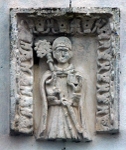 In the 16th century one mostly finds saints associated with the three monastic orders which evangelized Mexico, appearing along monastic walls, cloister walks, and church sanctuaries. The 17th century brought new “soldiers of God” to Mexico, introduced by other religious orders and a growing diocesan presence which helped disseminate their familiarity and appeal. By the 18th century saints were ubiquitous in cathedrals, parish churches, hacienda and palace chapels throughout Mexico, appearing in the form of paintings, exterior stone and interior estofado sculpture.
 |
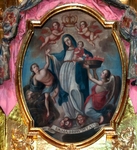 Mary was officially proclaimed Mother of God at the The Council of Ephesus in 431 and her virginity made doctrine in 649 at the Fourth Lateran Council. She grew to become the most beloved figure in Catholicism. Much of what is known about her, from Conception to Assumption, is by way of four specific texts in the New Testament Apocrypha, a collection of sacred writings outside of canonical scripture. Her many manifestations reference specific geographic locations, both in Europe and the New World, or particular events, whereas others are named after any number of her special attributes.
 |
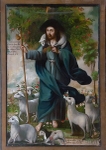 While biblical scenes from Christ’s ministry before and after he entered Jerusalem are common, the focus in Mexico is on his Passion. As part of the Trinity he appears with the Holy Spirit (above portrayed as a white dove) and God the Father, whose physical representation is usually otherwise proscribed save for in altar attic paintings. Christian apocrypha are sources for other, more esoteric themes like the Harrowing of Hell from the gospel of Nicodemus.
 |
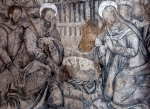
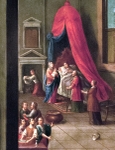 Many religious events are readily recognizable, due to their longtime representation and dissemination in ecclesiastic art history. The vast majority in Mexico are New Testament but occasionally Old Testament themes materialize, most noticeably in the apse of the 16th century Franciscan convento at Zempoala, Hidalgo. Non canonical events are innumerable, intriguing and often inscrutable, their origins lying in apocryphal texts written over the centuries and colored by regional settings.
 |
Return to: Gallery